
Sitemize hoşgeldiniz.
Tarih: 02-10-2026
Saat: 03:36
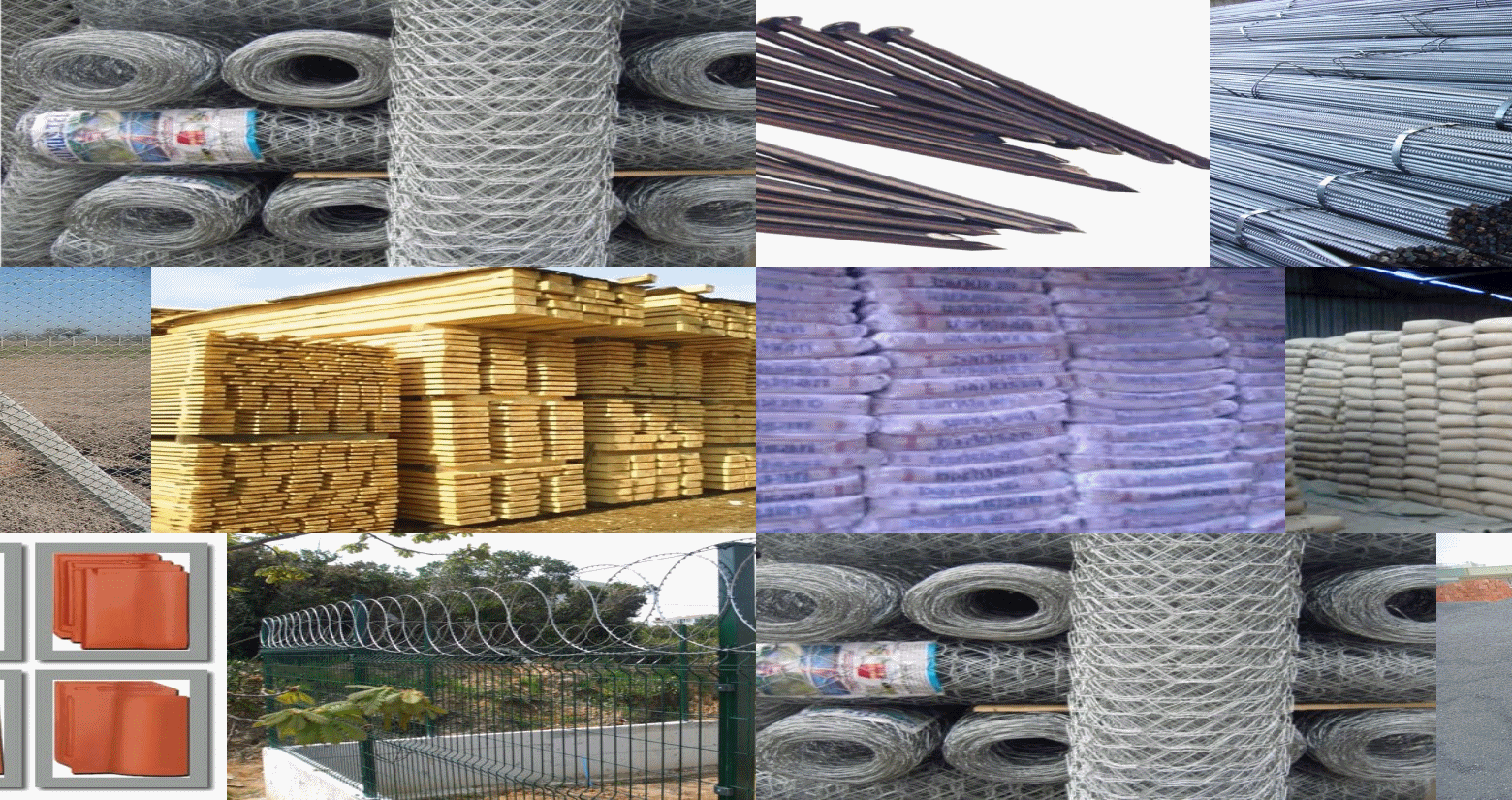
Gönenbaba İnşaat Malzemeleri Sanayi ve Ticaret LTD. ŞTİ. Yerköy/YozgatGönenBaba Ticaret, Odun, Kömür, Demir, Çimento, Kireç, Tuğla, Kiremit, Galvanizli Tel, Beton Direk, Kum ve Çakıl satışlarımız başlamıştır. |

Üye Panelİ
Anket
GÖNENBABA TİCARET

KATEGORİLER
TAKVİM
| P | S | Ç | P | C | C | P |
|---|---|---|---|---|---|---|
| « Oca | ||||||
| 1 | ||||||
| 2 | 3 | 4 | 5 | 6 | 7 | 8 |
| 9 | 10 | 11 | 12 | 13 | 14 | 15 |
| 16 | 17 | 18 | 19 | 20 | 21 | 22 |
| 23 | 24 | 25 | 26 | 27 | 28 | |
POPÜler YAZILAR
SON YORUMLAR
Yazar: gonenbaba
 Tarih: 11 Eylül 2025 / 13:41
Etiketler:
Tarih: 11 Eylül 2025 / 13:41
Etiketler:
The rapid advancement of space exploration technologies necessitates increasingly sophisticated navigation strategies to ensure mission success. A particularly intriguing concept gaining traction in recent years involves the manipulation of orbital pathways through innovative trajectories, one of which is notably referred to as the space switcheroo trajectory. This methodology exemplifies how dynamic trajectory planning can optimise fuel efficiency, address complex gravitational influences, and enable novel mission profiles.
Understanding Trajectory Optimization in Interplanetary Missions
Traditional mission planning has relied heavily on gravity assists and Hohmann transfer orbits to minimise fuel consumption. However, as missions become more ambitious—such as crewed lunar bases or asteroid mining ventures—researchers are pushing the boundaries of trajectory design. Advanced pathways like the space switcheroo trajectory are emerging as revolutionary tools, allowing spacecraft to perform complex maneuvers by exploiting gravitational influences in creative ways.
The Concept of the Space Switcheroo Trajectory
At its core, the space switcheroo trajectory involves a spacecraft strategically shifting its orbit through a series of gravitational assists and orbit perturbations, effectively “switching” between different orbital pathways. This approach can be visualised as a deliberate sequence of trajectory segments that leverage celestial bodies’ gravitational pulls to alter a spacecraft’s course efficiently.
Key Attributes of the Trajectory
| Attribute | Description |
|---|---|
| Gravity-assisted maneuvering | Utilizes planetary or moon gravity to change velocity without added fuel consumption. |
| Multi-orbit segments | Includes carefully planned orbital insertions to “switch” between pathways. |
| Fuel-efficient transfers | Reduces propellant use, enabling longer or more complex missions. |
| Trajectory flexibility | Allows dynamic course adjustments in response to mission requirements. |
Real-World Applications and Technical Insights
Recent simulation studies and mission designs have demonstrated the potential benefits of trajectories akin to the space switcheroo trajectory. For instance, in asteroid rendezvous missions, such pathways enable spacecraft to meet targets with minimal fuel expenditure, lower mission costs, and increased payload capacity.
“Employing advanced trajectory techniques such as the space switcheroo not only enhances mission robustness but also expands the operational envelope for robotic and crewed missions alike,” comments Dr. Elaine Roberts, a leading space dynamics expert.
One notable example is the trajectory planning involved in the compositional exploration of near-Earth objects (NEOs). By segmenting the transfer into multiple gravitationally assisted phases, missions can dynamically react to unforeseen challenges or changing mission parameters.
The Broader Industry Perspective
Agencies like NASA and ESA are increasingly investing in trajectory optimization algorithms incorporating concepts similar to the space switcheroo. These methods, rooted in astrodynamics and optimal control theory, leverage modern computational power to generate feasible paths that were once considered impractical.
Furthermore, commercial entities such as SpaceX and emerging lunar gateway programmes are exploring trajectory designs that embrace gravitational assist maneuvers for rapid transit and sustainable operations beyond Low Earth Orbit (LEO).
Future Prospects and Strategic Implications
As the commercial and governmental space sectors evolve, the importance of innovative trajectory concepts like the space switcheroo trajectory will only grow. They hold the promise of transforming long-haul missions into more manageable and cost-effective ventures, paving the way for ambitious human colonisation, resource extraction, and interplanetary trade.
In conclusion, the intersection of advanced astrodynamics and trajectory engineering exemplified by the space switcheroo trajectory signifies a critical frontier in space exploration. As navigation algorithms become increasingly sophisticated, they will continue to redefine what is possible in the realm of human reach beyond Earth.
Explore Further
To understand how innovative trajectory designs are shaping our journey into deep space, visit Pirots for Play and discover the cutting-edge developments in orbital mechanics and mission planning.
Oppss! Hiç yorum yapılmamış!
İlk yorumu neden sen yapmıyorsun?
İlk yorumu neden sen yapmıyorsun?
YORUM YAP
GönenBaba Ticaret : İnşaat Mazeleri, Bağçe Mazemeleri, Kışlık Mazemeler,
Odun, Kömür, Demir, Çimento, Kum, Çakıl, Kireç Tuğla, Kiremit, Çivi, Direk
ve Kendi üretimi olan GALVANİZLİ TEL ile siz Hemşerilerimize hizmet
vermekdedir. YERKÖY/YOZGAT
Gönenbaba İnşaat Malzemeleri Sanayi ve Ticaret LTD. ŞTİ. Yerköy/Yozgat
Bütün hakları saklıdır.
Bütün hakları saklıdır.
